Horsebox Trailer Buyer’s Guide
Whether you are moving a single pony to a local show or transporting two warmbloods across the country, the right horsebox trailer makes the journey safer for your horse and less stressful for you. At Rollins Farm Trailers, we have been supplying and servicing trailers from our base in Cambridgeshire for over 25 years, and the topics below are the ones we come across most often.
Horsebox trailer vs motorised horsebox
A horsebox trailer is a towed unit. You hitch it to a suitable tow vehicle, and the car or truck provides all the motive power. A motorised horsebox, by contrast, is a self-contained vehicle with its own engine, cab, and living area. Both carry horses, but they sit in completely different legal and financial categories.
The distinction matters most when it comes to driving licences. A standard category B car licence allows you to tow a trailer up to a combined maximum authorised mass (MAM) of 3,500 kg, provided the trailer’s MAM does not exceed the unladen weight of the towing vehicle. If the combined weight exceeds 3,500 kg, you need a B+E entitlement, which requires a separate practical test. Motorised horseboxes follow a different set of rules entirely: vehicles up to 3,500 kg GVW (gross vehicle weight) can be driven on a standard car licence, which is why the Morris Trailers Equinox, for example, is built to exactly that 3,500 kg threshold. Anything heavier requires a C1 or C licence.
For most private horse owners buying a towed trailer, the practical question is whether your car can legally and safely pull the unit you want.
UK towing requirements for horsebox trailers
Getting the tow vehicle right is not optional. UK law sets out clear rules, and the consequences of getting them wrong range from a fine to a serious accident.
Licence categories
If you passed your car driving test before 1 January 1997, you automatically have B+E entitlement and can tow heavier combinations. If you passed after that date, you hold a standard category B licence, which limits you to a combined train weight of 3,500 kg. To tow heavier outfits, you need to pass the B+E test. Check your licence counterpart or the DVLA’s online service if you are unsure what categories you hold.
Weight matching
The 85% rule is widely recommended in the equestrian community, even though it is not a legal requirement. It states that the loaded trailer weight should not exceed 85% of the towing vehicle’s kerbside weight. A trailer loaded with two horses can easily reach 2,000 kg or more, so a lightweight family hatchback is rarely suitable. Check your vehicle’s handbook for its maximum towing capacity, and always weigh the loaded trailer if you are unsure.
Trailer brakes
Any trailer with a MAM over 750 kg must have its own braking system. All standard double horsebox trailers exceed this threshold, so an overrun braking system is fitted as standard on models like the Ifor Williams HBX range. Unbraked trailers are only suitable for very light loads.
Once you have confirmed your towing setup is legal and safe, the next step is choosing the right trailer configuration for your horse.
Horse height, hands, and choosing the right trailer size
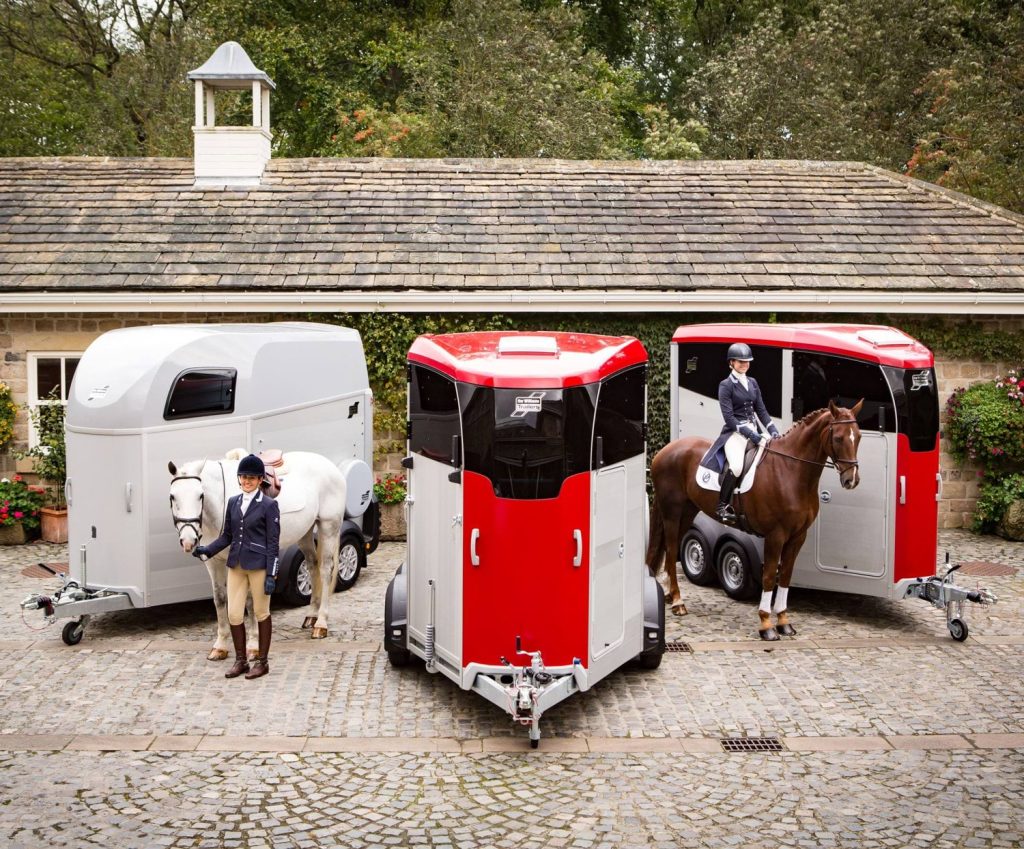
Ifor Williams publishes clear sizing guidance for its HBX range. The HBX-403 is a single-horse trailer designed for horses up to 16.2hh, with a wider stall than the double models to give a single horse more lateral room. The HBX-506 is a double trailer, also rated to 16.2hh per stall, and suits the majority of sport horses and cobs. The HBX-511 is the larger double, accommodating horses up to 17.2hh, making it the right choice for warmbloods, draught crosses, and larger sport horses.
If your horse is close to the upper limit for a given model, always go up a size. A horse that is cramped during transport is more likely to scramble, injure itself, or develop a reluctance to load. You can browse the full horsebox trailer range we carry, including individual product pages for the HB506, HB511, HBX506, and HBX511.
Servicing and long-term ownership
A horsebox trailer that is serviced regularly lasts significantly longer and is safer to use. Annual servicing should cover brake adjustment and condition, bearing inspection and regreasing, tyre condition, lighting, hitch wear, and a full check of the floor and bodywork.
Ifor Williams recommends specific service intervals for its trailers, and genuine parts are the right choice for maintaining warranty validity and fit. We stock a wide range of genuine Ifor Williams parts and accessories, and our workshop handles servicing and repairs on all trailer makes and models. See our other services page for full details on what we offer, including parts supply and professional repairs.